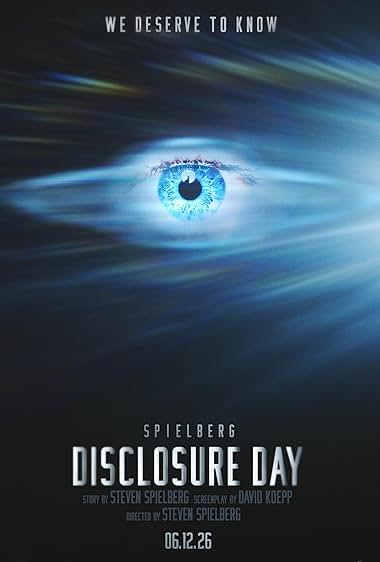
Mindframes Show Notes Episode 121 — Disclosure Day (2026)
Directed by: Steven Spielberg Written by: David Koepp Starring: Emily Blunt, Josh O’Connor, Colin Firth, Colman Domingo, Eve Hewson, Wyatt Russell IMDB: https://www.imdb.com/title/tt15047880/
Special guest: Tarek Fayoumi (movieswithtarek.com), director of the Chicago Independent Film Critics.
Episode Summary
In this episode of Mindframes, Michael and Dave — joined by returning guest Tarek Fayoumi — discuss Disclosure Day (2026), Steven Spielberg’s return to the alien genre and his first big sci-fi swing since War of the Worlds.
The conversation works through Spielberg’s recurring obsessions (renegade heroes, shadowy government forces, ordinary people swept into something enormous), Janusz Kamiński’s return to the diffused-light, lens-flare look, and John Williams’ 30th collaboration with the director — before splitting hard over whether the film’s hopeful thesis actually lands. Comparisons run from Close Encounters of the Third Kind, E.T., and War of the Worlds to Contact, Minority Report, and Coppola’s Megalopolis as a fellow “late master with something to say.”
Verdicts split three ways: Michael 2.5/5, Dave 3/5, Tarek 4/4.
Thematic Discussion
Disclosure Day asks whether an undeniable, truthful image can still unite people in a cynical age — Brian Tallerico’s “undeniable image” framing, run through the show’s central question: not is there proof? but does proof still work on us?
Michael argues the truthful image isn’t wounded but dead — a shared reality the film is nostalgic for, but one that no longer functions when people deny what they’re shown. Dave counters that the film’s real hope is empathy and human-to-human connection replacing the broken image, while conceding Spielberg doesn’t earn that buy-in the way his early work did. The film ends not on a revelation but on Margaret turning to the camera, saying “Listen,” and cutting to black — proof getting humanity to the threshold, with faith and empathy left to carry it the rest of the way.
Timestamps
Note: recording was split into two files; Part 2 times below assume the parts run continuously (Part 2 offset by ~50:03). Verify against the stitched audio.
Time Segment 00:15 Intro & setup; welcoming guest Tarek Fayoumi 02:33 Spielberg as a director — recurring themes 03:21 Premise & the Wardex setup (spoiler-free) 08:43 Return to the alien genre vs. his recent dramas 10:01 Cinematography — Kamiński, lens flares, the “awe” look 28:12 John Williams’ 30th collaboration; film & score preservation 31:17 Spoiler-free reviews begin 31:47 Michael’s review (2.5/5) 38:47 Dave’s review (3/5) 43:02 Tarek’s review (4/4) ~45:10 Spoiler section begins ~45:42 The alien reveal & the decades of “disclosure” footage ~55:27 Thematic debate: empathy vs. the image ~56:08 “The truthful image is dead” — Michael’s core position ~60:17 The ending: “Listen” and the cut to black ~74:31 Closing thoughts — can we still believe in a unifying image? ~74:56 Next episode tease Films & Directors Mentioned
- Close Encounters of the Third Kind (Steven Spielberg)
- E.T. the Extra-Terrestrial (Steven Spielberg)
- War of the Worlds (Steven Spielberg)
- A.I. Artificial Intelligence (Steven Spielberg)
- Minority Report (Steven Spielberg)
- Jaws (Steven Spielberg)
- Schindler’s List / Saving Private Ryan (Steven Spielberg)
- The Terminal / Catch Me If You Can (Steven Spielberg)
- The Fabelmans / West Side Story (Steven Spielberg)
- Jurassic Park / Indiana Jones and the Kingdom of the Crystal Skull (David Koepp & Spielberg)
- Contact (Robert Zemeckis / Carl Sagan)
- Explorers (Joe Dante)
- 2001: A Space Odyssey (Stanley Kubrick)
- Megalopolis (Francis Ford Coppola)
- Super 8 (J.J. Abrams)
- Watching the Skies (Norwegian sci-fi)
- Poltergeist / Gremlins (Spielberg-produced, 1980s)
- The Outer Limits — “The Architects of Fear”
Contact
Web: https://mindframesfilm.com Facebook: Mindframes Network: Now Playing Network Email: info@mindframesfilm.com