The Odyssey (2026)
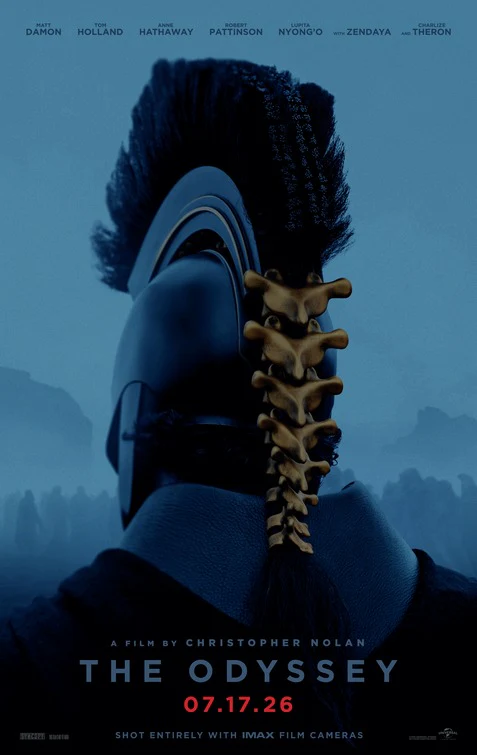
Directed by: Christopher Nolan Written by: Christopher Nolan Starring: Matt Damon, Anne Hathaway, Tom Holland, Robert Pattinson, Charlize Theron, Samantha Morton, Zendaya, Lupita Nyong’o, Elliot Page, John Leguizamo, Benny Safdie, Jon Bernthal, Himesh Patel, Mia Goth, Bill Irwin, Travis Scott IMDB: [IMDB LINK]
Episode Summary
In this episode of Mindframes, Michael and Dave discuss The Odyssey (2026), Christopher Nolan’s three-hour adaptation of Homer — a $250 million epic and the first narrative feature shot entirely on IMAX 70mm.
The discussion covers Nolan as an auteur and whether the “never made a bad movie” claim holds up, the practical-effects approach to the Cyclops and Circe, the deliberately cold Northern palette imposed on the Mediterranean, Ludwig Göransson’s score, and an ensemble so large the hosts concede they can’t get to everyone. After the ratings, the spoiler section turns to the film’s central choice: the Olympian gods have been removed while the monsters remain, and what that does to Odysseus’ moral agency.
Comparisons range across Nolan’s own filmography, Troy, The Northman, and the sword-and-sandal epics of the 1950s and ’60s.
Reviews
Michael: 4.5 / 5 — came out thinking four, and it has only grown in his esteem since. Praises the baseline of visual and musical quality, Damon working better as a lead than expected, and a supporting cast that carries every stop on the journey. Docks it for a cast so crowded it distracts, and for an ending too in love with its own moralism.
Dave: 4.5 / 5 — would watch it again in a heartbeat. Calls it a film that grabs hold of empire, heroism, reverence, and humility all at once, and rates the separation of gods from monsters as pitch perfect. His one dent in the fender: the film plays a little episodic, a series of very large encounters rather than a single build.
Thematic Discussion
The Odyssey removes the Olympians but keeps the monsters. Circe, the Sirens, and the Cyclops are all simply part of the natural world here; it’s Athena and Zeus who stay shadowy and inferred. Michael’s reading is that this absence exists to hand moral agency back to Odysseus — if the gods were visibly steering, his guilt over the Trojan Horse wouldn’t be his to carry.
That guilt is framed through xenia, the Greek code of hospitality. Odysseus offered a gift that turned out to be murder, and comes to believe that breaking that norm is what set his civilization’s collapse in motion. The hosts draw the parallel to the erosion of political and social norms in contemporary America, and to the film’s closing turn — the Bronze Age is ending because of the Sea Peoples, and the Greeks realize they are the Sea Peoples.
The episode’s central disagreement is over Athena. Dave reads her as constructed: she wears the face of a priestess Odysseus watched his own men murder in her temple, and the film is showing how humans build gods out of guilt and the sense that something is sacred. Michael pushes back that the film sustains a genuine ambiguity — the idea that gods appear in human form is planted repeatedly, and the priestess is decapitated at the exact moment Athena’s statue is, which leaves open that Odysseus may believe they killed a god. He points to the same ambiguity in the Cyclops’ cry to Poseidon, which some of the crew claim to hear and neither Odysseus nor the audience does.
Neither host resolves it, and both prefer it that way. Michael’s position is that the ambiguity is the answer rather than the absence of one — something underpins their world that they don’t fully see and are damaging anyway, whether that’s Zeus and Poseidon or simply decency and the value of human life. Dave, arriving from a position of religious faith, says he likes that Odysseus has to live in the same uncertain world the rest of us do.
The structural evidence they land on: Homer ends with a deus ex machina, Athena descending to stop the cycle of revenge. Nolan cuts it. Nobody intervenes, so Odysseus abdicates, gives the throne to Telemachus, and sails west with Penelope — a change that hands the ending’s moral weight entirely to the man.
Timestamps Time Segment 00:00 Intro & setup 05:08 Nolan’s filmography — is he an auteur? 08:51 Practical filmmaking and visual style 09:37 IMAX 70mm and the limits of the format 14:40 Hoyte van Hoytema 17:16 Why the Mediterranean looks cold 19:39 Ludwig Göransson’s score 25:20 Travis Scott, the bard, and the casting discourse 28:56 The ensemble 39:39 Reviews & ratings 49:56 Spoiler section begins 52:18 Xenia and the collapse of norms 54:50 The gods and moral agency 56:12 The Athena reveal 1:01:46 The case for ambiguity 1:05:03 “We’re the Sea Peoples” 1:09:02 The ending Nolan changed 1:19:36 Final interpretation debate — are the gods there? 1:26:49 Closing thoughts Films & Directors Mentioned
- Memento — Christopher Nolan
- Inception — Christopher Nolan
- The Prestige — Christopher Nolan
- Interstellar — Christopher Nolan
- Dunkirk — Christopher Nolan
- Tenet — Christopher Nolan
- Oppenheimer — Christopher Nolan
- Troy
- The Northman
- Dune
- Saving Private Ryan
- Fruitvale Station — Ryan Coogler
- Creed — Ryan Coogler
- Black Panther — Ryan Coogler
- Sinners — Ryan Coogler
- Minority Report
- The Whale
- Anemone
- Disclosure Day — Steven Spielberg
- Barbie
- Michael
- John Ford and Monument Valley
- Hans Zimmer
- The sword-and-sandal epics of the 1950s and ’60s
Contact
Web: https://mindframesfilm.com Facebook: Mindframes Network: Now Playing Network Email: info@mindframesfilm.com